
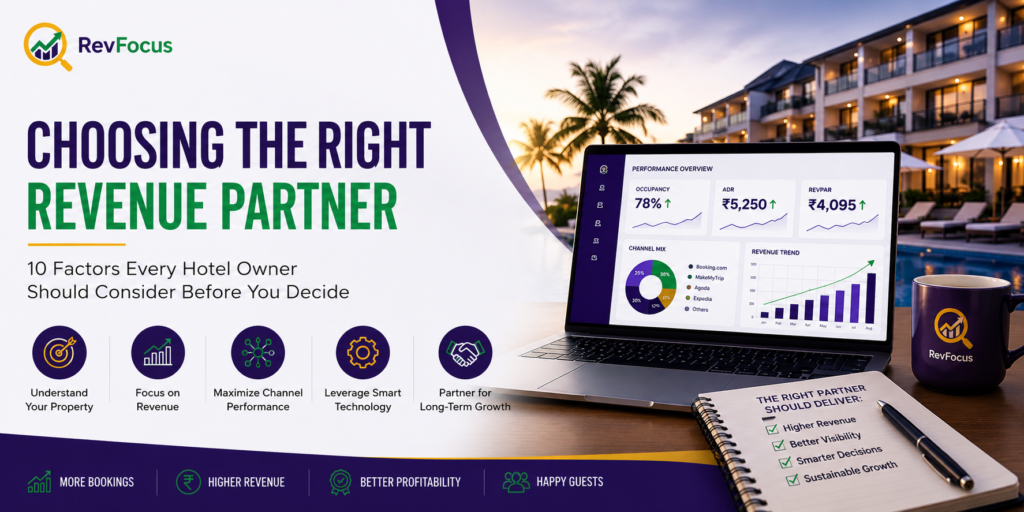
How to Choose the Right Hotel Revenue Management Company
Choosing a hotel revenue management company is not simply about finding someone who can increase your room rates.
The right revenue management partner should help you sell the right room, to the right guest, at the right price, through the right channel, at the right time.
With hotels, resorts, and homestays increasingly dependent on OTAs such as MakeMyTrip, Booking.com, Agoda, Expedia, and others, revenue management has become much more than changing room prices.
But how do you know which hotel revenue management company is actually right for your property?
Instead of choosing based on promises like “increase your revenue” or “get more bookings,” here are 10 important factors hotel owners should evaluate before hiring a revenue management company.
1. Do They Understand Your Property?
Every hotel is different.
A 20-room budget hotel, a 100-room business hotel, a resort, and a homestay cannot follow the same revenue strategy.
Before hiring a company, check whether they understand:
- Your property type and location
- Number and types of rooms
- Target guests
- Current occupancy
- Average Daily Rate (ADR)
- Seasonal demand
- Local competition
- Your major booking channels
A good revenue management company should first understand your property before recommending a strategy.
2. Do They Focus on Revenue, Not Just Bookings?
More bookings do not always mean more revenue.
For example, a hotel may increase occupancy by selling rooms at heavily discounted prices. The occupancy percentage may look good, but the overall revenue and profitability may not improve.
A professional revenue management strategy looks at multiple metrics, including:
- Occupancy
- ADR (Average Daily Rate)
- RevPAR (Revenue Per Available Room)
- Room nights
- Total room revenue
- Booking pace
- Cancellation trends
- Channel performance
The objective should be profitable growth, not simply filling rooms.
3. Do They Have a Clear OTA Strategy?
OTAs can be powerful sources of bookings, but simply being listed on multiple OTAs is not enough.
Ask how the company plans to manage your OTA presence.
This may include:
- OTA listing optimization
- Room and rate setup
- Content optimization
- Photos and descriptions
- Availability management
- Pricing strategy
- Promotions
- Visibility improvement
- Channel performance analysis
Your property should not just be “live” on OTAs. It should be positioned properly to attract the right guests.
4. How Do They Decide Your Room Prices?
One of the most important questions to ask is:
“How do you determine my daily room rates?”
Avoid companies that follow a fixed pricing approach without considering market conditions.
Hotel pricing can change based on:
- Demand
- Seasonality
- Weekdays vs. weekends
- Local events
- Competitor pricing
- Booking window
- Occupancy
- Historical performance
- Last-minute demand
A strong revenue management company should be able to explain why your rates are changing—not simply tell you that they have changed.
5. Do They Use Data to Make Decisions?
Revenue management should be data-driven.
Before hiring a company, ask what data they monitor and how frequently they review it.
A good partner should ideally track your performance over time and compare it with relevant market and competitor information.
Ask questions such as:
- What KPIs do you track?
- How often do you review performance?
- Do you monitor competitors?
- How do you identify demand changes?
- How do you measure the success of your strategy?
If the strategy is based mainly on assumptions, it may not deliver consistent results.
6. Can They Manage Multiple Booking Channels?
Many properties sell rooms through multiple channels.
For example:
- MakeMyTrip
- Goibibo
- Booking.com
- Agoda
- Expedia
- Yatra
- EaseMyTrip
- Airbnb
- Direct bookings
Managing each channel individually can become time-consuming and can also create inconsistencies in rates and availability.
Ask whether the company has experience managing multiple OTAs and whether they can coordinate these channels effectively.
If a Channel Manager is involved, also understand how the revenue management company will work with it.
7. Will You Receive Regular Performance Reports?
Transparency is important.
You should know what is happening with your property’s performance—not wait until the end of the month to discover whether things improved.
Before signing a contract, ask:
“What reports will I receive, and how often?”
Useful reports may include:
- Daily revenue
- Room nights
- ADR
- Occupancy
- OTA-wise revenue
- OTA-wise room nights
- Monthly performance
The reporting system should make it easy for hotel owners to understand what is working and what needs improvement.
8. Do They Have a Clear Communication Process?
Even a great strategy can fail if communication is poor.
Ask who will be responsible for your property and how you will communicate with the team.
Clarify:
- Who is your point of contact?
- How quickly are requests handled?
- How frequently will performance be discussed?
- Who approves major pricing or promotional changes?
- How are urgent issues handled?
A good revenue management partner should feel like an extension of your hotel team—not an outside company that you rarely hear from.
9. Are Their Fees Transparent?
Price should not be the only deciding factor.
A cheaper service is not necessarily better if it results in poor OTA visibility, weak pricing decisions, or missed revenue opportunities.
Before hiring a company, understand exactly what you are paying for.
Ask:
- Is the fee fixed or commission-based?
- Is there an onboarding fee?
- Is OTA listing included?
- Is OTA management included?
- Is reporting included?
- Is Channel Manager support included?
- Are there additional charges?
A transparent pricing structure helps avoid misunderstandings later.
10. Can They Show Real Experience and Explain Their Results?
Finally, look beyond marketing claims.
Instead of asking only:
“Can you increase my revenue?”
ask:
“How have you achieved results for properties similar to mine?”
Look for experience with properties comparable in:
- Location
- Room count
- Property type
- Target audience
- Price range
More importantly, ask the company to explain what they changed and why.
A credible revenue management company should be able to discuss strategy, metrics, challenges, and outcomes without relying entirely on vague promises.
Questions to Ask Before Hiring a Hotel Revenue Management Company
Before signing an agreement, ask these five questions:
- What will you do differently for my property?
- Which KPIs will you use to measure success?
- How frequently will you review and adjust pricing?
- What reports and updates will I receive?
- What exactly is included in your fees?
The answers can tell you a lot about how seriously a company approaches revenue management.
Common Mistakes Hotel Owners Should Avoid
Choosing a revenue management company based only on the lowest price is one of the most common mistakes.
Other mistakes include:
- Choosing a company only because it promises a specific revenue increase
- Focusing on occupancy instead of profitability
- Not asking about reporting
- Ignoring OTA performance
- Not checking relevant experience
- Signing without understanding the pricing structure
- Expecting immediate results without considering seasonality and market conditions
Revenue growth is usually the result of consistent analysis, strategy, optimization, and execution—not one pricing change.
So, Who Is the Best Hotel Revenue Management Company?
There is no single company that is automatically the best for every hotel.
The right choice depends on your property’s needs, current challenges, target market, distribution strategy, and growth goals.
Instead of asking:
“Who is the best revenue management company?”
a better question is:
“Which revenue management company understands my property, explains its strategy clearly, measures the right metrics, and can demonstrate how it will help me improve?”
That is the company worth considering.
How RevFocus Approaches Hotel Revenue Management
At RevFocus Services, our approach is built around the same principles discussed above: understanding the property first, optimizing OTA performance, monitoring revenue metrics, and using data to support pricing and distribution decisions.
Our services include Revenue Management, OTA Management, OTA Listing Optimization, and Channel Management support for hotels, resorts, and homestays.
Rather than using the same strategy for every property, the focus is on understanding each property’s market, performance, distribution channels, and revenue opportunities.
If you are evaluating revenue management companies for your property, use the factors above as a checklist—and choose the partner that can clearly demonstrate how their strategy will work for your hotel.
Final Thought
The best revenue management company is not necessarily the one making the biggest promises.
It is the one that can understand your numbers, explain its decisions, communicate clearly, and consistently work toward better revenue performance.
Do your research, ask the right questions, and evaluate the strategy—not just the sales pitch.